
... social media ... ugh! ... but for general news, please consider following me on my instagram: https://www.instagram.com/wolfrobertstratmann/
July 2026
On this 29-minute-long 5-track EP South Korean pianist Sujae Jung and German bassist Wolf Robert Stratmann team up with guitarist Steve Cardenas and drummer Marko Djordjevic to perform five of Jung’s and Stratmann’s originals. The songs have their basis in jazz, but this is reflective music which also has its feet in ambient, New Age and improvisation, with the band leaders often in control of the melody and the guitar and percussion providing additional nuances and touches to broaden the sound. In this instance the cover photo is a great depiction of what is contained within, as there are times when this is sparse and almost windswept, yet it is also very deep indeed if one takes the time to listen.
The fifth musician, space, is hugely important on this album as the sentient musicians work closely alongside to ensure they never take away from what that is adding to the album, the result being something which is incredibly clean where one can almost hear the musicians breathe. It is scored as opposed to being composed live, but each take their own journey to expand on what is being presented to them aurally, and in some ways it makes me think of material which normally comes to me from Discus Music, and I am sure that anyone who tends to investigate that catalogue will also get great deal from this. It is a bright and easy to listen to album which is never easy listening, but instead invites the listener to come in and pull up a chair and just listen to a quartet who really know what they are doing.
- Kev Rowland, US
January 2026
DownBeat Magazine Editors Pick
Korean pianist Sujae Jung and German bassist Wolf Robert Stratmann, known for their collaborative contemporary jazz recordings and live performances, expand their long-established New York-based duo into a quartet for their latest release with the inclusion of U.S. guitarist Steve Cardenas and Serbian drummer Marko Djordjevic. The result is a highly refined program of five nature-inspired original compositions that flow with intricate collective interplay while tapping the wealth of globe-spanning, genre-transcending musical influences engrained deep within these four exceptional artists, who converge as one unified spirit on this synergetic outing. Tellingly titled Confluence and recorded in front of an audience at the recently opened Second Take Sound Studio in Manhattan, the album has an authentic live record vibe that nicely complements the high-fidelity sound listeners have come to expect from Jung Stratmann projects. The album opens with a graceful, whirling group take on “Tree Huggers,” the title track of Jung and Stratmann’s recently released duo EP. “Summer Whale,” a sun-warmed, wave-riding composition in 5/4, is an older piece by the duo that makes its recording debut in this deep-water quartet setting. No strangers to the ebb-and-flow of rubato playing, Jung and Stratmann gently lead the way on an ethereal approach to the beautifully melancholic ballad “This Wine Tastes Very Dry.” A major highlight of Confluence is “The Pull,” a bright and joyful track with catchy melodic lines riding on mesmerizing ostinato bass patterns. A trio performance of Jung’s dreamlike “After Sunset,” another rubato ballad whose transcendent harmonies have the power to hold listeners rapt in reflection, cools convictions and elicits feelings of an enveloping dusk as the program draws to its natural conclusion.
- Ed Enright, DownBeat Magazine US
The Jung Stratmann Quartet consists of Sujae Jung on piano, Wolf Robert Stratmann on double bass, Steve Cardenas on guitar, and Marko Djordjevic on drums. Together they present Confluence, an original jazz EP of original, instrumental songs inspired by themes ranging from a whale's ocean journey to a tribute to the New York City music scene. Confluence is an immersive delight for jazz connoisseurs, highly recommended. The tracks are Tree Huggers (Jung); Summer Whale (Jung and Stratmann); This Wine Tastes Very Dry (Stratmann); The Pull (Stratmann); and After Sunset (Jung).
Jazz People Magazine, KR

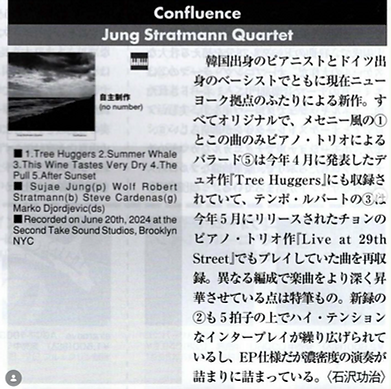
Koji Ishizawa for JAZZ LIFE, JP

Best album of the year Award, Indie Bouelvard, US

"The main event. Best Album 2025 goes to "Confluence" by Jung Stratmann Quartet.
Jung Stratmann Quartet recorded something that works from first track to last—disciplined, purposeful, never wasting your time. This is what happens when a band refuses to compromise.
The jury—ourselves included—scored every nominee. We tallied all the points, and "Confluence" came out on top with the highest total score. This is your Album of the Year.
Congratulations"
- Indie Boulevard US
Dezember 2025
Roots Music Report - Review & Interview
The release of Confluence by NYC based Jung Stratmann Quartet is a collaborative effort featuring the combined musicianship and compositional styles of Sujae Jung (piano) and Wolf Robert Stratmann (double bass), assisted on the album by Steve Cardenas (guitar) and Marko Djordjevic (drums). Released in 2025, the album clocks in just under a half hour.
Korean-born pianist Sujae Jung teams with double bass player, German-born Wolf Robert Stratmann and the results make for a breezy album of easy-on-the-ears acoustic-based jazz that never wears out its welcome.
The 5 tracks here were composed by either Sujae Jung or Wolf Robert Stratmann with track 2 “Summer Whale” being a co-composition. The addition of electric guitarist Steve Cardenas gives the album a kind of Metheny-Mays late 1970s fusion sound while drummer Marko Djordjevic provides the album with a solid jazz beat.
Interestingly, Ms. Jung has several side projects including Intertwined, which combines Korean music and jazz but her music with Jung Stratmann Quartet is mainly airy and accessible Americana style jazz. Her lead off track, “Tree Huggers” is among the best on the album combining memorable melodies with expert musicianship.
NYC continues to be a melting pot of various musical styles and cultures and, although as proven through the decades, the Euro-Asian team of Jung Stratmann Quartet is the latest example of the continued abundance of sonic diversity of jazz culture in NYC in the 2020’s. In fact, a track here called “The Pull”, written by Stratmann, is an imaginative, lighthearted tribute to the nightlife and after hours music scene in New York City.
Jazz fans looking to enjoy a lighthearted, laid-back half hour of acoustic jazz are advised to give a listen to Confluence by Jung Stratmann Quartet. www.sujaejungmusic.com / www.wolfrobertstratmann.com
RMR SPEAKS TO JUNG STRATMANN QUARTET
RMR: Can you give us some timeline as to when the Jung Stratmann Quartet came together, how many albums have you released and how does the Confluence album bring your sound up to date contextually within the band’s framework and mission?
Sujae Jung: This album is actually our first release as a quartet, and also our first time recording together with Steve and Marko. Many of our compositions are inspired by nature and by moments from our everyday lives. Living in a huge city like New York, it’s not always easy to stay close to nature, and sometimes its importance fades into the background of our daily lives. Both Wolf and I grew up in places where nature was a big part of our surroundings, so composing and playing these pieces feels like our own way of rebuilding that connection and interweaving it with our big city lives.
Just as different musical elements come together to create something beautiful, playing with Steve and Marko allowed the music to become more colorful, more textured, and more alive. Their voices help the pieces grow in new directions, and ultimately we feel the quartet sound brings our music to listeners in a more vivid and dynamic way.
Wolf Robert Stratmann: Right! And I would add to that the following: Sujae and I have been playing music and living life together now for 6 years. We started playing together back in 2019 after our first Ensemble lesson at the Royal Conservatoire during our undergrads. Those were humble beginnings, and I am so proud that we have gotten to the point where we can collaborate with artists who we not only admire but also who have been our friends and teachers at the same time. Playing with Steve and Marko makes a lot of things so easy. Often I tend to be so critical with myself but when Sujae and I play together with Steve and Marko, I can forget about all of it and just take the music for what it is in that very moment.
RMR: Can you tell us where you are from originally and how and when and if possible why did you come to NYC? The mystique of New York still goes on with every generation of artists and musicians. What are your favorite places to play music and listen to music in the city and have you played live in other states and other parts of NY State or other states yet?
Sujae Jung: I’m originally from South Korea, and I moved to New York in the fall of 2023. The story really begins with my husband and musical partner, Wolf. As we were finishing our bachelor’s, we both wanted to continue with our master’s degrees—and, of course, stay together while coming from different countries. Wolf had always dreamed of studying in the U.S., especially in New York. So we decided to visit, and even though I had moved to the Netherlands in search of “freedom,” I felt an even bigger sense of freedom here. The city’s diversity, music scene, and energy pulled me in immediately. After that trip, I auditioned for schools and was accepted to The New School.
Even though I’ve been here only about two and a half years, luckily, I could play in some places. The Stone stands out the most—it’s where I performed my recital, watched Wolf’s and my friends’ concerts, and saw so many inspiring artists. I also love venues like Soapbox Gallery, where we performed for our Duo E.P. releases, The Jazz Gallery, where I saw one of my musical heroes, Kenny Barron, Mezzrow, Smalls, Blue Note, and Village Vanguard—places that shaped my musical life in the city. I haven’t performed in other states yet, but I hope to as new opportunities come in the future.
Wolf Robert Stratmann: Yup, New York, always a fun time guaranteed! I am from Bielefeld, Germany. Some folks in Germany joke that that town doesn’t exist, ha! It is a nice beautiful city though. I think my dream of New York started when I bought a picture of the Flat Iron Building for me room during my high school days. After I finished High School I moved to Berlin to learn about music production but also to start playing the electric bass. My teachers Björn Werra and Simon Pauli took great care of introducing me to many of the famous bass players that came out of New York City, so naturally I engrossed myself with much of the music from there.
In the beginning of 2019 then I finally managed to do a three week trip with a good friend to New York City. We slept on the floor and the couch of an apartment where another friend was living and let us graciously stay without having to pay her rent. Those were wild three weeks! We went out literally every night to see concerts and dive into the music scene. One of the most memorable ones for me was the first time I saw and heard Wayne Krantz. He played at the 55 bar back then. Sadly that place does not exist anymore but I remember as it was yesterday when Wayne turned up his amp and the sound wall he created with Evan Marien on bass and Cliff Almond on drums, washed over me like a big ocean wave. I had sore muscles in my cheeks from smiling so much. Nowadays places that have been hosting a few of the old 55 bar heroes are the Bitter End and Nublu. Although I have been doing mostly acoustic music in the past 6 years, I always try to stay connected to my electric roots and the people that made me pick up my instruments to begin with.
Performance-wise we have mostly performed locally, aside from very few occasions upstate. We went to the Living Jazz / Jazz Camp West in 2024 on the West Coast too, where we met a lot of wonderful new friends and were lucky to do an open stage with Allison Miller and Richard Howell. Shout out to the two! I hope they are well. Performing in the US in general as a foreign student is tricky. There were a lot of legal restrictions. We stayed mostly local because that was also the safest bet for us.
RMR: Also tell us how the band added two additional players Steve Cardenas (guitar) and Marko Djordjevic (drums). Describe the chemistry of the quartet sound and in your estimation what tracks stand out as favorites?
Sujae Jung: Wolf and I first got to know Steve during our time at The New School. We’re both huge ECM lovers, so when we discovered there was an ECM ensemble taught by Steve Cardenas, we immediately felt, “This is where we need to be.” We learned a lot from playing in his ensemble, and later, when Wolf started taking private lessons with him, I joined a few sessions. The trio chemistry was so natural that Steve eventually said, “We should get a gig together,” and we followed through right away.
Wolf met Marko a few years earlier through his previous teacher, and we reconnected with him while preparing for our school auditions in NYC. His positive energy and his playing felt like a perfect fit for the direction we were heading. After performing together a few times, working with him on the album felt like a natural next step.
As a quartet, the balance is beyond what I imagined. Steve’s gentle but clear musical presence and Marko’s reliability, mixed with surprise, create a beautiful contrast with Wolf’s and my compositions. The blend feels grounded yet open, especially in rubato moments. Our single “This Wine Tastes Very Dry” captures that chemistry well. And honestly, as a composer and a player of this album, I can’t pick a favorite—I love every single track.
Wolf Robert Stratmann: Right. Another shout out to my old mentor Roberto Badoglio, the Italian and Berlin based electric bass virtuoso, who put Marko and me in contact back then in in 2019 when I visited New York for the first time. It is really a great coming together of so many strains of influences of our personal and artistic lives on this album! My favorite track might actually be “Tree Huggers”. It just sounds so happy!
RMR: The lead off track on your new album Confluence is called “Tree Huggers” What inspired that track? What are a couple of your other personal favorites on the Confluence album?
Sujae Jung: There was a period when I was writing mostly sensitive, introspective pieces—ballads and rubato music. “Tree Huggers” came toward the end of that phase, when I suddenly wanted to write something brighter and more positive. At the time, I was completely absorbed in Keith Jarrett’s My Song album—especially “Country” and “Questar”—and that 70s–80s warmth naturally influenced the piece. My favorite memories are still tied to nature in Korea: Hiking with my family, spending time in parks, and feeling surrounded by mountains and trees. I’d heard that hugging a tree can be emotionally healing, and I loved that image. I wanted this tune to give listeners that same comforting, uplifting feeling.
Another track that’s very meaningful to me is “After Sunset”, which also comes from my memories of Korean nature. I grew up in Busan, a city surrounded by the sea, so the ocean has always been a big part of my life. Right before moving to the U.S., I went to my favorite beach to watch the sunset with my family, and it was the most beautiful sunset I’ve ever seen. There was a summer festival happening—people dancing, surfers chasing waves late into the evening, families and couples watching the sky turn gold over the water. The sunlight was so strong it even tinted the blue sea yellow. In that moment, I thought, “I have to write a song about this. I want people to feel what I’m feeling right now.” No matter how beautiful buildings or city lights can be, the beauty of nature has a different depth.
Wolf Robert Stratmann: Another fun one is “Summer Whale”. Sujae and I wrote this on a hot summer day in The Hague. It was summer break and yet we were always practicing and working out some music. The beach was calling loudly though and so we said to ourself: Ok, if we manage to write a tune, then we can go out to the beach! The idea started with the imagery of a blue whale floating in the ocean. Then we thought it could be fun if the chord progression has a bit of an upward motion. Later on, our good friend Björk Blöndal wrote some lyrics in Icelandic to it. She gave the whole piece a fantastic story of a blue whale that is on his annual commute but gets a little home sick. I hope one day we can make a great recording with her together once more.
RMR: What keyboards and basses do you play on the Confluence album and can you give us a brief description your musical training and the contrasting compositional styles and musical acumen on the album, hitting on the high points. Also you have some side projects and other bands that you play with. How do your other projects fit into and compare to the Jung Stratmann Quartet sound on the new album?
Sujae Jung: On Confluence, I play a Yamaha grand piano. I started learning classical piano when I was seven, and I’ve been playing ever since. I didn’t study jazz seriously until high school, but that classical foundation has always stayed with me. Touch is everything for me—I try to communicate my emotions through the weight, clarity, and honesty of each note. That’s also why I continue to practice classical piano. As a pianist and composer, I’m deeply influenced by Bobo Stenson, Keith Jarrett, and Kenny Barron—their voicings, their singing melodic lines, their simplicity that somehow speaks even louder, and their sincerity. Those qualities guide me both in writing and improvising.
Outside of the quartet, I’m involved in two other projects with very different identities. In Airplane Ears, an improvised drum-and-bass trio, I play a Soma Terra Synthesizer and the Korg Minilogue XD. There, I focus on simple but strong hook-like melodies and clear rhythmic ideas. In Intertwined, where I blend Korean traditional music with contemporary jazz, I play both the Soma Terra and the piano. That project is all about exploring Korean rhythms, ornamentations, and the beauty of Korean landscapes through sound. Even though the three projects are very different in concept and texture, the connecting thread is honesty.
Whether I’m improvising, playing something electronic, or writing something rooted in Korean tradition, my main goal is the same: to express a sound that is truly mine—not copying anyone, not performing on autopilot, but staying sincere to the emotion and intention of the music. That’s the element that ties all my work back to the Jung Stratmann Quartet as well.
Wolf Robert Stratmann: My current upright bass is an old German bass from the late 1800’s or early 1900’s. It’s like a Juzek or Pfretzschner but has no label inside. The story that it must have been put together by different workshops. It sounds incredible, but because of that missing label it did cost significantly less than a Juzek or Pfretzschner of similar age and quality would have cost. I use Genssler BoM strings nowadays but on the album I use a mix of Evah Pirazzi on E A and an Olive D from Pirastro, and then a Gamut G gut string. A bit Joe Martin inspired. I just can’t go without the guts any more. The cool thing about Genssler’s is, that they sound like gut, but they are synthetic. So no animals harmed, ha!
Nowadays, I am really consumed by creating all this original music, Sujae’s Intertwined, Airplane Ears and a lot of experimental music that I for now put under the umbrella of my Project Natural sound. I mostly play upright nowadays but then when I play electric, I usually gravitate to my trusty Fender P-Bass. It’s a custom shop, looks older than it actually is, but sounds like it has been around for the past 50 decades. I switch between flats and round-wounds, sometimes I use a pick and then a bunch of pedals. Those change a lot, that keeps me inspired. Usual suspects though are my 3 Leaf Audio Octaver, the EHX Frequency Analyzer and the CAPO pre-amp from Jed Freer. I also use their Sisma amp and Minerva Cabinet.
I really always loved making music on a huge bandwidth. That’s just me. Some may be satisfied with one thing, but I like looking at things from many different perspectives. Sometimes I have to go down many rabbit holes. It’s a lot sometimes because you wanna do things fully and not half. Otherwise why do it all? For the future I hope to come up with a way to let all these different musical streams flow together in one project. That is my challenge for the coming years.
RMR: What were some of your choice musical influences and possibly some of your own personal album favorites both growing up and what about albums and artists are you listening to these days?
Sujae Jung: As I mentioned earlier, I’m deeply influenced by musicians like Keith Jarrett, Bobo Stenson, and Kenny Barron. Those influences came after I began studying and playing jazz more seriously. Before that, I actually grew up as a K-pop fan—I loved idol groups and their music, although I eventually lost interest after learning more about the inner workings of that industry. I also enjoyed listening to GoGo Penguin, especially during the time when I studied in Seoul, and of course, I admire the greats—Miles Davis, Bill Evans, Charlie Parker, and John Coltrane. All those sound worlds shaped both my playing and my approach to music. I shouldn’t forget to mention Ornnett Colman.
Wolf and I both took an ensemble led by Jane Ira Bloom at The New School, and got a chance to learn about Ornnett’s music deeply. His music blew my mind immediately, and I felt how lucky I am that I got to know about him and his music. The freedom in his music, the melodies that are so beautiful, something like that I had never heard before and it instantly influenced my compositions and playing. These days, my listening is quite broad. I still listen to Korean traditional music, and I continue to explore many ECM artists. Keith Jarrett and Kenny Barron remain constants on my playlist. Since starting Airplane Ears, I’ve also been listening to electronic artists like Boards of Canada and Aphex Twin. And recently, I've been especially drawn to the music of Marcin Wasilewski and Julia Hülsmann.
Wolf Robert Stratmann: That’s like a deserted island list thing here! Oh man, there are so many. From the top of my Head, here are 10 albums and people and I would take with me then!
Boards of Canada: The Campfire Headphase
The Beatles: Rubber Soul
The Frames: Longitude
Robert Badoglio: Lapse Of Worry
Kevin Scott’s King Baby “the Big Galoot”
Wayne Krantz: Krantz Carlock Lefebvre
Bobo Stenson Trio: Reflections
Ornette Coleman: The Shape Of Jazz To Come
Buster Williams: Something More
Hank Jones, Charlie Haden: Come Sunday
Nowadays I listen to a lot of Korean Traditional Music. I have made a playlist for KCCNY a while back. K-MUSIC PLAYLIST No. 10. Maybe you can find it online.
Jazz-wise I listen to a lot of Kenny Barron, Barry Harris and Bud Powell these days. Every second Sunday I try to steal myself away to the Barry Harris Workshop in Manhattan and enjoy learning a new thing or two in this lovely little community. And of course I can’t go without listening to my Electric bass hero Anthony Jackson. Rest in Peace AJ!
At this point I also have to give a special shout out to my mentor Kevin Scott who has been through thick and thin with me the past 6 years. I can’t even put in words how much and in how many ways he has influenced me.
RMR: What plans do you have for 2025 and 2026 as far as writing, recording and playing live concerts and will there be a follow CD release to the Jung Stratmann Quartet Confluence album. What kind of album would you like to write and record next?
Sujae Jung: We’ll be celebrating the release of our quartet album with a concert on December 3rd at Ki Smith Gallery. After that, things will shift quite a bit because we’re preparing to leave New York and move to Germany, so many of our 2026 plans will naturally take place there. Before the move, we’ll be performing our first duo concerts in Korea early next year, and I’ll also continue studying Korean traditional music, which has become an important part of my artistic direction.
Two other albums shall be released too. Our electronic project Airplane Ears will be putting out its debut album, produced together with our musical hero Kevin Scott, which we’re very excited about. I’m also working on the first album for Intertwined, my cross-genre project that blends Korean traditional music with contemporary jazz. For the Jung Stratmann Quartet, the New York release concert will likely be our final performance in the city for a while, but we’re already thinking about future opportunities—possibly a European tour or more quartet concerts with Steve and Marko. And yes, we’d love to make a follow-up album when the timing is right.
Wolf Robert Stratmann: Not much more to add to that, other than that we are grateful for the opportunity of this interview and that we hope everyone will stay safe and well out there!
Indie Boulevard - "Confluence" album interview
Jung Stratmann Quartet has released Confluence — an album featuring New York scene legends Steve Cardenas and Marco Djordjevic. Korean pianist Sujae Jung and German bassist Wolf Stratmann, in conversation with Indie Boulevard, explain how academic education coexists with spontaneity and why nature becomes a language for describing urban chaos.
Jazz education is always a game of balance: too much theory kills intuition, too little leaves a musician without tools for dialogue. Jung & Stratmann went through conservatories in The Hague and New York to ultimately create Confluence — an album where academic training and living energy don’t contradict each other but exist in a strange, almost symbiotic connection. The recording was done live before an audience, with no retakes allowed — a decision that says much about the quartet’s priorities. The studio brought together musicians from four countries with different pedagogical systems behind them. How do they find common ground? And what happens when a composition written for a duet suddenly grows to include guitar and drums — does it get diluted or, conversely, reveal what was always hidden?
In the conversation, we discuss how understanding of a partner’s music changes over years of working together, why trees and whales become metaphors for describing the expat experience in a metropolis, and how two musicians from Busan and Bielefeld attempt to compensate for the absence of nature in Manhattan’s concrete jungle. This is a conversation about the collision of worlds — academic and intuitive, urban and natural, student and professional — and about what emerges at the point of their intersection.
Hey guys, thanks for taking the time to chat with me. You and Sujae met at the Royal Conservatoire in The Hague, then both continued your studies at The New School in New York. Over these years, you’ve evolved from a student duo to a quartet featuring legends like Steve Cardenas and Marko Djordjević. It’s interesting how many great jazz collaborations begin in academic settings but then get lost in the hustle of professional life. For you two, it’s the opposite—the partnership only deepens. Tell me, how has your musical understanding of each other changed since you first sat down to play together? What do you hear in each other now that you didn’t hear then?
Wolf: Hey, thank you! It is a pleasure for us, and we are grateful for being interviewed by you and the Indie Boulevard! Those are great questions to start with!
Sujae: Yes, they bring back some good old memories! Remember, Wolf, when you asked me to practise with you together for the first time after our first ensemble lesson back in fall 2019? Our teacher, Miro Herak, made us practice an F-Blues and mess around with rhythmical kicks, cross rhythms, and even shortening and lengthening the form. (Laughs) We couldn’t do any of it at first, but we kept on trying regardless until we managed that night in that room without a window in the old conservatory building. I was so tired afterwards, haha, but it was also so much fun!
Wolf: Ha, yes! As usual, you had it all down way before me and then helped me the rest of those hours patiently until I finally managed too! Haha
Sujae: I think that’s really a big one, after so much time of studying, practicing, playing, composing and working together, to know each other’s strengths and weaknesses so well. So we can really help each other out now, not only to make up for each other’s weaknesses but really make the other person shine and bring out the best in them.
Wolf: I agree. After all that, that is what this music is all about for us, the players, and who they truly are.
You recorded Confluence live in front of a select audience at Second Take Sound Studio. That’s a bold decision, considering the complexity of your material. What’s more important to you, technical perfection or that irreplicable energy that only emerges in the presence of people? And did you feel pressure knowing there wouldn’t be a second take?
Sujae: I would definitely go for the energy. Sure, you wish sometimes that you would like to have a second take on things, but then sometimes it gets too fuzzy anyway. Jazz for us has always been about community and connection in the first place. And in a concert, it’s almost like an exchange. You give something from yourself, you send it out while playing, and then you receive something back from the audience, of course. It’s much in a way like a shared process in which you might even learn something about the others and yourself.
Wolf: Totally! And even though we spend countless hours in the practice room, days and nights on end, in fact, honing our skills, all that matters is the very moment of the performance, it all comes down to. No matter how much you try to be perfect, the beauty of improvised music is that in the moment, it never goes as planned; everything is different from what you expected it to be. It’s just human, one day you feel like this, the next day like this. It doesn’t make sense to pretend that it’s different; otherwise, the conversation is not honest and might get very boring very quickly.
“Tree Huggers” exists in two versions—as a duo and as a quartet. You say you almost cried listening to the quartet version because each musician’s personality comes through so strongly and swirls together so gracefully. It makes you think about the nature of arrangement: sometimes adding instruments dilutes the original idea, and sometimes it reveals what was always hidden there. Sujae, when you wrote this piece, did you anticipate it would ever become a quartet piece? And what specifically changed in its emotional message when guitar and drums joined your dialogue?
Sujae: Most of the time when writing music, I try to have the players in mind that I want to play it with. Because all instruments sound so different depending on who plays them. With “Tree Huggers,” I was probably in one of those phases again, listening a lot to Keith Jarrett’s European Quartet Records with Jan Garbarek, Palle Danielson, and Jon Christensen. Wolf knows that music very well too, so with him, it’s easy going for that vibe. And then with Steve and Marko, it was so easy again because they totally understood where this piece was coming from. I think that’s why Wolf cried a little when listening back to our record, because he was so happy hearing that joy, liveliness, almost childlike bliss coming from the four of us playing together and letting it out.
You describe this album as an example of what “passing the torch” can look like in jazz. You’re playing with musicians who were your teachers at The New School— Satoshi Takeishi and Ned Rothenberg—but now you’re colleagues on stage, recording an album of your original compositions. Did something change in your relationship to them as musicians when the recording studio equalized you? And at what moment did you feel the transition from student to colleague was finally complete?
Wolf: To be very honest, I think this possibility of playing together happened initially because Steve and Marko never implied any hierarchy between us ever. I think it’s like one of our former teachers, Saxophonist David Glasser said once: “We are all on the same way, man. I’m just a little further down the road than you, standing there with a flashlight, lighting you the way.” Steve and Marko have shared the stage and life experiences with some of Sujae’s and my most favourite artists, some of which were undoubtedly integral to our artistic development. In the moment of performance, all these influences and experiences whirl together. It’s hard to put into words; it’s like something you can only really experience by playing or really deeply listening to one another. It’s like their influences shine through in their playing, and that influences and inspires us, their energy, their ideas, intentions, stories, and feelings.
Confluence described as nature-inspired—trees, whales, sunsets. But there’s something interesting happening here: you’re using the language of the natural world to describe deeply urban experiences of migration, displacement, and the pull of cities like New York. It feels like a kind of code-switching between the pastoral and the cosmopolitan. Is nature for you a way to process the chaos of being an expat musician in New York? Or is it something else entirely—maybe a way to stay connected to your roots while living this transatlantic jazz life?
Sujae: Yes, absolutely. We both come from cities where vast nature is really easily accessible. Busan in Korea, Bielefeld in Germany, and of course, where I met in The Hague, there is the North Sea just a short bike ride away from you, as well as that wonderful dune area, the nature reserve, Meijendel. New York is very intense in a way, everything here is artificial. A concrete jungle. You can not get anywhere without looking at commercials and ads. Nature here is optional to a large degree. Sure, you have Central Park or Prospect, but it takes an hour or even longer for us sometimes to get to those places, and then it’s never really quiet. To Upstate New York it takes even more than two hours sometimes. I feel like we have a kind a longing on one hand, which we try to compensate for with creating music that is inspired by nature, and on the other hand, we live and work in a metropolis that sustains our art. It’s this duality of our lives that sometimes cannot be merged, but then again, maybe they do live in symbiosis with one another.
You both received a Living Jazz “Jazz Camp West” scholarship in 2024, and you received the Dean’s Award at The New School for outstanding academic achievement. Academic recognition in jazz is a double-edged thing: on one hand, it’s validation; on the other, jazz has always been the music of outsiders, rebels, people who didn’t fit into institutional frameworks. Your education started with audio design and music production in Berlin, then jazz in The Hague, then New York. How do you merge the academic approach to composition with that raw, intuitive impulse without which jazz loses its soul? Does it ever seem to you that education can “over-teach” spontaneity?
Wolf: I might have had my moments where I have fought a bit internally with some academic systems that institutions have in place sometimes. But I would say in the end, I feel extremely grateful and privileged for the support I have received from the institutions where I was able to study. Although many of my past years were extremely challenging, these institutions really nurtured me to become the musician I am today. Studying music is also never just a plain study where you hang your head in the books and disappear into dry theory. It’s always like a dual degree kind of thing. You are working out stuff with people all the time, and then this takes you very quickly to opportunities outside of the Institution. It’s like music school is like a hub, a vast storage facility of invaluable quantities of information and resources, were you meet and make new friends, assemble tools, maybe get your butt kicked once or twice in a while gently by some of the professors, but then you got to take it all out to the gig, apply it and get on from there.
Confluence brings together musicians from Korea, Germany, the US, and Serbia—different generations and jazz traditions. But I’m curious about the practical reality of this internationalism. When you’re in a studio with musicians who were trained in different pedagogical systems, who listened to different records growing up, who have different cultural relationships to silence, space, dynamics—how do you find a common language? Is there a moment in rehearsal where you realize you’re not speaking the same musical dialect, and how do you bridge that?
Sujae: That is a great question, and I might be able to answer this with a metaphor, one of our former teachers, Saxophonist Jane Ira Bloom, once said so humorously: “It’s like as if we all stand around a chair in a circle. We all look at the chair from a different angle, and so each one of us talks about what we see from a different perspective. But in the end, we all talk about the same darn old thing. A chair.”
The album was mixed and mastered by Ken Rich at Grand Street Recording in Brooklyn. There’s been this ongoing tension in jazz between the “purity” of live, unprocessed sound and the possibilities of studio craft. Some purists say that too much mixing ruins the authenticity of jazz; others argue that’s a dated, fetishistic view. Where do you stand?
Wolf: We recorded all in one room, so naturally, there was quite some spill on all tracks. Jason Rostkowski did a great job in making the best out of the recording situation, but some of the bleeding is just unavoidable. Ken Rich then helped fantastically to clean up those tracks. For us, the mixing and mastering was about getting clarity to each instrument’s track, so that everyone’s ideas and playing can be heard and enjoyed well for the listener on any sound system they use. And that is really a must, in my opinion.
New York has changed dramatically in recent years. The jazz scene that drew you and Sujae there—the late-night sessions, the abundance of venues, the sense that you could stumble into genius on any given Tuesday—many say that’s fading or gone. Rents have pushed musicians out, venues have closed, the pandemic changed everything. Do you still feel that pull to New York as strongly as when you first arrived? Or are you and Sujae part of a generation that’s having to reimagine what a jazz career looks like when the traditional ecosystem is collapsing?
Wolf: That is a great question and a very timely one as well. In fact, we are leaving the States this December to first visit family in Korea and do a few months of study about Korean Traditional Music there, and then move to Germany for an indefinite time. Partially family reasons, but also political and economic ones, have brought us to this decision.
Sujae: Yes. We came to New York solely for the art scene, and I have to say we really found what we were looking for. For us, it still was an abundance of venues and a time filled with opportunity, so much that you sometimes had trouble keeping it all together.
Wolf: I get that point, that New York is changing drastically. But that is actually a large city’s constant: Change. The beauty is that people and cultures from all over the world stream in and out of the city for whatever reasons they may have for doing so. To be in that stream, that’s what it is about in the end. You might get swept away, but you’re certainly in for a ride! Haha
Sujae: In many ways, though, it is extremely tough as a foreign artist to sustain a living here. We have friends hustling multiple jobs and sacrificing their health to be part of it, just to have enough money to barely get by. In some cases, there is not much time left in a week to work on your own art. And that’s crucial, because you can twist and turn it however you want it, but in the end, as an artist, you need time to figure out what and how you want to create.
Wolf: Possibly, any generation has to reimagine a bit what the best way is now to have their music sustain them. But that is not necessarily tied to New York. It’s everywhere on our planet like that. In some places, however, the starting conditions might be a bit better than in others, and those impressions may vary from person to person as well, depending on their personal values.
Confluence out now. But jazz is ultimately about the live experience—the conversation between musicians and audience, the spontaneity that can’t be bottled. What are your plans for bringing this music to audiences in the flesh?
Wolf: Since we are leaving New York and we wanted to keep next year as open as possible for us to have enough room and time to decide where and how we want to start the next chapter in our lives, we have one concert this formation, scheduled. The album release concert.
Sujae: December 3rd, 7 pm at Ki Smith Gallery in Manhattan, New York!
New York, 170 Forsyth St, New York, NY 10002, USA
You can also find it here:https://www.kismithgallery.com/event-details/jung-stratmann-quartet-confluence-album-release-feat-steve-cardenas-marko-djordjevic
And in general, you can find out about all our other concert dates on our websites: https://www.sujaejungmusic.com, https://www.wolfrobertstratmann.com, and our Instagrams: @wolfrobertstratmann, @sujaejung_pi
- Anita Floa, Indie Boulevard US
Indie Boulevard - "Confluence" album review
Jung Stratmann Quartet Finally Recorded What They’ve Been Playing for Years: In-Depth Review of the New Album.
When Sujae Jung and Wolf Robert Stratmann were studying at The New School in Manhattan, they were hardly thinking about creating an album that would, years later, force a reconsideration of the boundaries of quartet jazz. The Korean pianist and German bassist first played as a duo, then expanded to a quartet, inviting guitarist Steve Cardenas (the very same one who spent years with Paul Motian) and Serbian drummer Marko Djordjevic. Confluence was recorded as a reimagining of five compositions that existed in other formats. The musicians took old material and broke it down to molecules, reassembling it in a configuration where improvisation has consumed composition so thoroughly that distinguishing between them is impossible.
New York jazz is currently in a strange state. On one hand, young musicians on the Brooklyn scene are furiously returning to the spiritual jazz of the seventies, recording long meditative sets with saxophones and African percussion. On the other hand, there’s the academic milieu, graduates of prestigious schools, virtuosos playing the most complex meters and harmonies, but often cold, sterile. Jung Stratmann Quartet falls into the gap between these camps. They’re reflective enough for the academics, but too free for the purists. Compositionally refined enough for conservatory snobs, but too inclined toward an improvisational approach for fans of neat post-bop.
This is both their strength and their difficulty. Confluence is hard to sell to anyone with a direct pitch. This is an album for people who’ve already listened to plenty of jazz, tired of the obvious and searching for music that will work with them, not against them. Five tracks recorded in the studio with minimal intervention—you can hear breathing, the creak of pedals, the acoustics of the room. The result is technically imperfect in places, but absolutely perfect in its aliveness. Far more alive than most contemporary jazz releases, polished beyond recognition.
“Tree Huggers” opens the album with a dialogue between piano and drums, and for the first two minutes I thought this would be yet another European free jazz with pretensions of philosophizing. Jung throws clusters, Djordjevic responds with rolls on the toms, but instead of an explosion, you get dialogue. When the bass and guitar enter, the composition takes shape, Stratmann playing pedal tones here, holding down the bottom while the others wander above. Midway through, Jung takes a solo that develops through repetition of minimal motifs—Philip Glass comes to mind, filtered through a jazz prism. The track ends as it began, refusing to give you any answers.
“Summer Whale” is built on the opposition of bottom and middle—bass and piano. Harmonically, the composition hovers over several centers, like Miles‘s modal jazz, only without his melodic generosity. Cardenas enters late, his notes chosen with indecent precision. Djordjevic here refuses to be a metronome. The middle section is given to a bass solo, and when everyone gathers back together, they play an almost unison line, then scatter. The track is cyclical—ending on the same note it began with.
“This Wine Tastes Very Dry” is the most fragile piece on the album. Jung begins with chords that balance between dissonance and consonance, never definitively choosing a side. Cardenas responds with delay, his phrases mirroring the piano. Djordjevic is almost silent for the first two and a half minutes—brushes rustling so quietly they could be mistaken for air conditioning noise. When he finally makes his presence known, the playing remains crumbly, fragmented. Harmonically, there’s no form here in the conventional sense. European jazz loves these through-composed structures, where everything is written from beginning to end without repetitions.
“The Pull” changes the rules of the game. After three compositions on the edge of atonality, this one returns to traditional jazz. Djordjevic sets up a bossa nova, Stratmann plays walking bass, Jung and Cardenas lead the melody in unison—a rarity on the album. The theme is simple, major, and after the previous tracks, it’s perceived as a revelation. The most accessible track on the album.
“After Sunset” closes the album with a ballad. Jung plays solitary chords with long pauses between them. Stratmann enters arco—with bow, sounding like a cello. Djordjevic works cymbals and brushes throughout the composition, almost inaudible. The middle section is a series of short solos, each musician speaking a few phrases and falling silent. The track concludes with a gradual fade—instruments drop out one by one, leaving the piano with a final chord that resonates, overtones layering, slowly dissolving. The album ends with the same instrument it began with—a cyclical structure.
Comparing Confluence to something specific is difficult because the quartet stands at a crossroads of influences. Echoes of late Motian are audible—the same love of space and silence. There’s the European chamber quality of ECM aesthetics, but without its characteristic coldness.
There’s one complaint, and it’s serious—you want more. The longest composition here is just over six minutes. “Tree Huggers” could have been a fifteen-minute exploration, “This Wine Tastes Very Dry” begs for ten minutes minimum. Perhaps this was the producer’s decision—keeping tracks short to maintain attention. Perhaps the musicians themselves decided that conciseness matters more than completeness. In any case, this album is listened to in one breath, simply frozen in place.
The album demands a prepared listener. If your acquaintance with jazz is limited to Kind of Blue and Spotify playlists like “Jazz for Work,” Confluence will seem like a monster under the bed. This is jazz for people who’ve already gone through standards, bop, modal, free, and are now looking for the next step.
It’s interesting how the album will live on. Recordings that demand time and attention rarely become hits, but sometimes they accumulate an audience slowly, through word of mouth and recommendations. Confluence might become an album that people discover a year, two, five years after its release. Jung and Stratmann have built something sustainable over their years working together. Expanding to a quartet with Cardenas and Djordjevic added color and depth without losing intimacy. Four musicians from four countries (Korea, Germany, USA, Serbia) found a common language through jazz, which ceased being an American genre long ago and became an international dialect. Confluence is an album that could only have been recorded in New York, where these cultural streams meet daily on the streets, in the subway, in the clubs.
Confluence is one of the most important jazz releases of 2025, but recognition will come slowly. The album is against trends—against virality, against instant access, against easy consumption. It demands investment of time and attention, promising in return depth and longevity.
- Anita Floa, Indie Boulevard US
The quartet of pianist Sujae Jung, bassist Wolf Robert Stratmann and guitarist Steve Cardenas is releasing Confluence, an EP that is filled with originals.
Pianist Sujae Jung (from South Korea) and the German bassist Wolf Robert Stratmann team up with guitarist Steve Cardenas and drummer Marko Djordjevic to perform five of Jung’s and Stratmann’s colorful originals on Confluence. While each of the musicians has their own individual sound, they blend to create a distinctive and highly appealing musical identity.
Indie Boulevard - "This Wine Tastes Very Dry" single review
Jung Stratmann Quartet’s “This Wine Tastes Very Dry” Is an Exercise in Elegant Tension
New York has always been a place where traditions collide and reimagine themselves. Jung Stratmann Quartet embody precisely this principle of cultural métissage: Sujae Jung‘s Asian meditativeness, Wolf Stratmann’s European chamber sensibility, Steve Cardenas‘s American freedom (who spent years alongside the legendary Paul Motian), and Marco Djordjevic‘s Balkan rhythmic inventiveness coalesce into a statement that belongs to all these traditions simultaneously and to none of them individually.
The new single “This Wine Tastes Very Dry,” which was released today in anticipation of the full-length album ‘Confluence‘, works as a perfect metaphor for the sound. Dry wine—a drink without residual sugar masking its character. This composition is stripped of ornamentation, cheap emotional effects, everything that makes jazz “pleasant” for the casual listener. It’s exposed, tart, demanding your willingness to accept it on its own terms.
I returned to this track again and again over the course of weeks, trying to understand why it holds attention despite its apparent lack of conflict. The composition opens with Jung‘s piano phrases that hang in the air with that particular suspension—when harmony is about to resolve, but the musician holds the tension for another moment, and another, forcing the listener to balance on the edge of anticipation. Stratmann‘s double bass materializes almost imperceptibly, his line entering so naturally, as if it had always been sounding, you just hadn’t heard it before.
Marko Djordjevic deserves separate discussion, because his approach to drums is radically different from what generations of swing drummers have taught us. For the first two and a half minutes he exists on the periphery of the sound field—brushes rustle on the snare drum so quietly that you could mistake it for external noise, cymbals ring at the edge of perception. Djordjevic builds tension through absence, through refusing to give what’s expected, and when he finally announces himself with a full rhythmic statement at 2:30, it’s perceived as an explosion, though dynamically he remains restrained. Cardenas on guitar, though appearing only at the very end, demonstrates that particular wisdom that comes only through decades of playing with musicians who understand the value of space.
Are they even improvising? Or is all of this written and rehearsed? A good question, and there’s no answer. When musicians play together long enough, the boundary dissolves. What’s written begins to sound spontaneous, what’s improvised settles like composition. The quartet has clearly logged dozens of hours together, and it’s audible—they anticipate each other, leave space, take it back without words.
The album Confluence may become one of the important jazz statements of late 2025.
- Anita Floa, Indie Boulevard US
Jazz Fun - JS 4tet "Confluence" album review
Zwei Stimmen, eine Vision – Confluence
Es stehen neue Werke der langjährigen koreanisch-deutschen Contemporary-Jazz-Kollegen, dem Pianisten Sujae Jung und dem Kontrabassisten Wolf Robert Stratmann, bereit. Durch die Erweiterung ihres Duos um die beiden renommierten Jazz-Ausnahmekünstler, den US-amerikanischen Gitarristen Steve Cardenas und den serbischen Schlagzeuger Marko Djordjevic, gewinnt ihre Performance an Raffinesse.
Das Album „Confluence” enthält fünf Originalkompositionen, teils Quartettversionen früherer Werke, teils völlig neue Titel, die den von der Natur inspirierten Kompositionsstil des Duos fortsetzen, aber auch ihre musikalischen Einflüsse weiter ausbauen. „Confluence” von Jung Stratmann wird am tba erscheinen. Das Zusammenspiel der internationalen, generations- und genreübergreifenden Besetzung fließt in einer bewegenden Komposition aus vier ausdrucksstarken Einheiten zusammen und verkörpert den verbindenden Geist der Jazzmusik. Es ist ein Beispiel dafür, wie „die Fackel weiterreichen“ aussehen kann. Aufgenommen wurde das Album von Jason Rostowski in einer exklusiven Live-Performance vor ausgewähltem Publikum im kürzlich eröffneten Second Take Sound Studio des Sängers, Songwriters und Dichters Reed Turchi in Manhattan, New York. Es setzt den warmen, hochauflösenden Sound des Projekts fort und fügt ihm eine authentische Live-Atmosphäre hinzu. Gemischt und gemastert von Ken Rich von Grand Street Recording in Brooklyn, New York, ist „Confluence” wirklich ein großartiges Zusammenspiel vieler.
Confluence besteht aus fünf Originaltiteln, von denen jeder ein tiefes Eintauchen in das komplexe Zusammenspiel der Musiker sowie eine Hommage an ihre engsten Inspirationsquellen ist. Das Album beginnt mit einer tiefgründigen Quartettversion von Jungs „Tree Huggers“, dem Titelsong ihrer kürzlich veröffentlichten Duo-EP. „Ich war so emotional, als ich unsere Aufnahme zum ersten Mal hörte!“, sagt Stratmann. „Es hat mich wirklich berührt, wie jede unserer Persönlichkeiten so stark zum Ausdruck kommt und sich auf so anmutige Weise miteinander vermischt!“ „Summer Whale“, eine dunkle, aber dennoch glückselige Komposition im 5/4-Takt, ist ein älteres Stück, das Jung und Stratmann gemeinsam komponiert haben und das nun endlich sein Debüt auf Platte feiert. Was als einfacher Vamp begann, um das offene Spiel im gleichmäßigen Achtel-Feeling zu erforschen und sich einen Wal vorzustellen, der durch die sonnengewärmten Wellen des Ozeans gleitet, entpuppte sich als ein Stück von tiefem emotionalem Wert. Nachdem die isländische Sängerin Björg Blöndal den Text dazu geschrieben hatte, erzählt das Stück die Geschichte eines Blauwals auf seiner jährlichen Wanderung von den kälteren zu den wärmeren Teilen des Atlantiks. Während dieser Reise kann er nicht leugnen, dass trotz all der wunderbaren Anblicke, denen er begegnet, immer wieder ein Gefühl von Heimweh aufkommt.
Auf dem Album folgt an dritter Stelle eine durchdachte Interpretation von Stratmanns „This Wine Tastes Very Dry”. Für Anhänger des Jung-Stratmann-Projekts ist es kein Geheimnis, dass Rubato einer der Lieblingsstile der beiden ist. Cardenas und Djordjevic stellen in dieser Hinsicht ihr beeindruckendes Können unter Beweis und präsentieren dem Zuhörer eine besonders weitläufige, zarte, fast ätherische Version dieser zutiefst melancholischen Ballade. Der vierte Titel, „The Pull”, ist nicht nur ein großartiger Übergang von dunklen Gefühlen zu einer helleren Stimmung, sondern auch eine doppelte Hommage an Stratmanns frühen Einfluss durch den E-Bass sowie an die Faszination, die die Musikszene in New York City auf jemanden ausüben kann. Beginnend mit einer an Jaco erinnernden Basslinie versuchen die Musiker, das freudige Gefühl einzufangen, das sich einstellt, wenn man der Anziehungskraft des Nachtlebens von New York City mit all seinen inspirierenden und meisterhaften Künstlern nicht widerstehen kann. Das Album endet mit einer Trio-Bonus-Performance von Jungs „After Sunset“, einer traumhaften Rubato-Ballade, deren transzendente Harmonien die Vorstellungskraft der Zuhörer anregen. Sie lassen einen lauen Abend in der Dämmerung mit atemberaubendem Blick auf die südkoreanische Küste vor dem inneren Auge entstehen und vermitteln das Gefühl, am Ende eines außergewöhnlichen Mehrgangmenüs ein üppiges Dessert zu genießen.
- Jacek Brun, Jazz Fun DE
November 2025
Thierry De Clemensat JS 4tet "Confluence" album review
Across the Blue Divide: Sujae Jung and Wolf Robert Stratmann’s Transcultural Quartet. If there’s one trait that seems to bind Korean and European jazz musicians, it’s their shared classical foundation, a discipline that so often shapes the direction of their artistry. From that rigorous training, many find their way either into the open field of experimentation or toward the sculpted lyricism of melody. Pianist Sujae Jung and bassist Wolf Robert Stratmann have clearly chosen the latter path, one that privileges balance, structure, and intimacy. Their quartet, rounded out by players who listen as deeply as they play, embraces simplicity as a philosophy rather than a limitation. At its core, the group’s sound grows from contrast: between the refinement of Jung’s Korean sensibility and the earthy precision of Stratmann’s German roots. The dialogue between their musical cultures doesn’t erase difference, it heightens it. What emerges is a shared language that sounds both carefully measured and strikingly spontaneous. Every note feels deliberate; every pause, charged with intention. In this quartet, one senses a kind of telepathy, an unspoken conversation where two worlds not only meet but also expand through each other. Their new album, Confluence, unfolds across five original compositions, each one a study in collective balance and emotional depth. The record opens with a bold quartet version of Jung’s “Tree Huggers,” first introduced on the duo’s recent EP. “I was so moved when I listened back to our recording,” Stratmann recalls. “I was deeply touched by how powerfully our personalities express themselves, intertwining with such grace.” That intertwining, an elegant tension between introspection and release, sets the tone for what follows. “Summer Whale,” composed in 5/4, swims in darker waters. The piece began as a modest vamp, a space for exploring open eighth-note phrasing and the image of a whale gliding through waves warmed by the sun. But over time, it became something more, a meditation on movement and memory. Later, Icelandic singer Björg Blöndal added lyrics (not featured here) about a blue whale migrating from cold to warm Atlantic waters, transforming the tune into a metaphor for passage and transformation. Water runs deep through Confluence, not just as imagery, but as an organizing principle. It evokes both the vastness separating Korea and Germany and the current that now unites them. This music lives in that tension: a paradoxical distortion where familiar sounds bend into something unfamiliar, and where dissonance becomes a form of beauty. The musicians exchange calls and responses, gazes and gestures, until their individual perspectives merge into what might be called a sensory identity, an aspiration toward universality through the specificity of shared sound. That same spirit animates “The Pull,” a composition that leads the listener from darkness into light. Stratmann tips his hat to his early years on electric bass, and to the hypnotic gravity of New York’s music scene, a city that still exerts a magnetic influence over his playing. By the time the record reaches its closing piece, “After Sunset,” the quartet has fully arrived at its destination. Here, the music breathes in total trust. There is no need for glances or cues; the musicians simply are, coexisting, conversing, creating. The track feels like an arrival not just for the group but for the idea of musical collaboration across cultural boundaries. Few ensembles achieve this kind of synthesis. One is reminded of Joe Zawinul’s Syndicate, which followed the legendary Weather Report. Admired for its diversity yet never quite reaching its predecessor’s acclaim, Zawinul’s later group may have been misunderstood, too forward, too fluid for easy classification. Yet where the Syndicate struggled against the weight of legacy, Jung and Stratmann’s quartet carries no such burden. They are building something patient and deliberate, letting the sound find its own shape. Confluence is, in that sense, aptly titled. It’s less a finished statement than an evolving process, a meeting point where geography dissolves and what remains is pure sound, pure exchange. For Jung and Stratmann, the music isn’t about bridging differences; it’s about inhabiting them, letting their currents mingle until the distinction between origin and destination becomes beautifully, deliberately blurred.
- Thierry De Clemensat, Paris Move
Jonathan Widran - JS 4tet"Confluence" album review
The soulful, rhythmic and impressionistic moods on Confluence, the compelling, richly exploratory debut EP by the Jung Stratmann Quartet, is rooted in and is an impressive, continuously shape-shifting outgrowth of the improvisational blend of drums and bass, lo-fi and electronic styles South Koren pianist Sujae Jung and German bassist Wolf Robert Stratmann create in their improv ensemble Airplane Ears. Truly an offbeat, freewheeling international jazz affair, the duo expands its artistry tremendously via its intuitive vibing with American guitarist Steve Cardenas and Serbian drummer Marko Djordjevic. To fully appreciate the uniqueness of the quartet, listeners should compare the versions of the collection’s anchor/bookend pieces “Tree Hugger” and “After Sunset” with the renditions Jung and Stratmann recorded as a duo earlier in 2025 on their Tree Huggers EP. The quartet transforms “Tree Huggers” from something of a darker introspective ballad to a higher energy, swinging and polyrhythmic romp highlighted by Cardenas’ tasteful soloing and Djordjevic’s hypnotic percussive fire. “After Sunset” is still a haunting ballad, but the quartet arrangement offers a more dramatic, dare we say cinematic flair based on Djordjevic’s adventurous drumming and hi-hat bravura. The EP also shines a spotlight on Jung and Stratmann’s unique storytelling skills as they create a fascinating, ever-evolving migratory journey of a blue whale (“Summer Whale”) and a cheerful, bustling paean to NYC (“The Pull”). The EP also includes “The Wine Tastes Very Dry,” a gently meditative late night piece with a wry sense of humor.
- Jonathan Widran, The JW Vibe
Jazz Journal UK - New Releases
They say : Jung Stratmann Quartet Confluence (Jung Stratmann) Street Date:December 3, 2025. The quartet of pianist Sujae Jung and bassist Wolf Robert Stratmann is releasing Confluence, an EP that is filled with picturesque originals that feature an attractive group sound. Its five selections range from a cinematic depiction of a whale’s journey to a tribute to the New York City music scene. (Jung Stratmann)
October 2025
Cadance Jazz World - album preview
Jung Stratmann Quartet’s upcoming album Confluence continues the Jung’s and Stratmann’s nature-inspired writing style, but also reaches out further to their musical influences. A heartfelt interplay of not only international and generation-spanning, but also genre-transcending personnel flows together in an evocative composition of four expressive entities, embracing the unifying spirit of jazz music and setting an example of what “passing the torch” can look like.
Mid 2025
Jazz Promo Services - "Confluence" release album page (US)
June 15 2025
Interview with Neon Jazz - Kansas City, on the new Jung Stratmann Duo "Tree Huggers" EP.
May 2025
Jung Stratmann Duo "Tree Huggers" EP release
The Korean-German Contemporary Jazz Duo Jung Stratmann presents their second EP, “Tree Huggers,” a collection of four original compositions exploring themes of nature and memory. Recorded at Brooklyn’s Bunker Studios, this EP showcases the unique interplay between pianist Sujae Jung and double bassist Wolf Robert Stratmann, offering a warm, high-fidelity sound that builds upon their debut EP, “Bird of Luck”. The duo’s intuitive musical conversation flows like a slowly rolling river, with their virtuosic abilities taking a backseat to the emotive and sincere quality of their performances. “Tree Huggers” features four distinct tracks that highlight the duo’s musical journey. The opening track, “After Sunset,” demonstrates their characteristic rubato phrasing and creative harmonic interplay. The title track draws inspiration from 1970s modern jazz while addressing environmental themes. “Green Waters” showcases Stratmann’s innovative phasing technique on the bass, creating an auditory image of forest streams. The EP concludes with “Only In Your Memory,” a folk-inspired piece that unexpectedly features Stratmann as a vocalist, adding an intimate layer of depth to the overall atmosphere. Throughout the EP, Jung and Stratmann’s ability to create space for each other allows the music to unfold naturally, moving between various registers, dynamics, and moods while maintaining a sense of intentionality and clarity.
Jan Fritz, Jazz Media & More
Early 2025
Jazz Media & More Artist Page (EU)